As part of the parental downsizing and de-cluttering efforts, I have become the new custodian of Grandma Sawyer's photos and papers that Dad had been keeping in boxes since bringing it all over from England after her death in 1995. I'm still sorting through it, but here's a favorite photo of Granddad in Australia when he was a Jackeroo in the 1920s. This photo is undated, but there are others with him on a polo horse dated 1928.
New Aquisitions
As part of the parental downsizing and de-cluttering efforts, I have become the new custodian of Grandma Sawyer's photos and papers that Dad had been keeping in boxes since bringing it all over from England after her death in 1995. I'm still sorting through it, but here's a favorite photo of Granddad in Australia when he was a Jackeroo in the 1920s. This photo is undated, but there are others with him on a polo horse dated 1928.
A Foray into Victorian London
Always, for me, finding individuals on the family tree inevitably becomes more about all the events and people giving historical context to a name inked on a dry, old page. The hope is always that you will come across direct references to a family member, but as that is fairly rare, then something interesting about their residence at the time in which they lived there, or where they worked, and who else of documented note was a part of their lives become the obvious points of attraction. Many entertaining imaginings about my family members have begun with just the smallest fact or detail.
This past weekend, I found one little morsel of information on a census that quickly became an interesting piece in the massive puzzle of Victorian London. My great-great-grandmother, Caroline (Ingrams) Sawyer, was listed on the 1891 census as being a servant for Lady Martha Christiana Nottage, residing at 35 Collingham Road, Kensington. I could not find Caroline's husband, Charles, anywhere on the 1891 Census (and still haven't found his record of death), but assume he had died young and Caroline had to go into service, as she had three children to support.
[Late entry: Charles Thomas Sawyer died 1883, aged 33.]
The next question, of course, after wondering what happened to Charles, was who was Lady Martha Nottage (who sounds like a character in a P.G. Wodehouse story). Here the fun begins. It turns out that she was the widow of a Lord Mayor of London named George Swan Nottage (photograph below). He died in office in 1885. Alas, I cannot find any pictures of Lady N., but she died 5 December, 1916.
And even more interesting, George Nottage was the co-founder of the London Stereoscopic Company, which specialized in mass production of stereoscopic photographs, becoming one of the largest photographic publishing companies in the world, sending their photographers all over the globe to take pictures.
The reason this photography connection is of particular interest, is because Caroline's son, also named Charles, my great-grandfather, was a photographer. He worked for the Medici Society and went around Europe photographing famous works of art for their high-end reproductions. Did he get his start with the LSC? Were these two companies connected in any way? The Medici Society was founded by Philip Lee Warner, and Lady Nottage's family name was Warner. I will look into that, because that would be quite interesting from our family history point of view if these two Warners were from the same family.
An interesting note about this company: it went into liquidation decades ago, but has since been revived by Brian May, the band member from Queen, who has had a long standing interest in stereoscopic photography (he's quite an interesting character - he also has a PhD in astrophysics that was interrupted by years of touring when the band became successful, and finally completed a few years ago).
Here's more information on the company:
http://www.londonstereo.com/index.html
http://blog.nationalmediamuseum.org.uk/2013/10/26/a-z-photography-l-is-for-london-stereoscopic-company/
Britain Goes to War
A guest blog entry today for a treat: my dear Papa has penned a poignant memoir essay to share with us recounting his experience as a young boy in the dark, opening days of his country at war. Enjoy.
*
How I Started the Second World War
("The
supreme art of war is to subdue the enemy without fighting.” From The Art of
War by Sun Tzu)
I was six when the Second World War
started and that day, 3 September 1939, after all these years is still a vivid
memory. It was a warm summer Sunday in a new housing development on the
outskirts of London where Mum, Dad, six months-old brother Rob and I had
recently moved. That Sunday I was in our back garden helping (or, so I believed
at the time) my father and other men from the neighbourhood dig a large and
deep hole in the dense unyielding London-clay subsoil. It took only a few
minutes of my enthusiastic assistance, aided and abetted by my friend Tony, in
the ‘big dig’’ before we were told to get out of the way of those slicing
through the clay with their shiny steel spades and hurling it skywards to land
on the rapidly growing mountain, as it seemed to me, of excavated material. “Go
play at the end of the garden”, we were ordered, “You’ll get hurt if you stay
here.”
Tony and I slowly clambered up the
ladder out of the deep hole wondering why we couldn’t stay and enjoy playing in
the dirt like all the grown-ups. Our scrambling all over the mountain of dirt
from the hole didn’t please those sweating excavators either. We were still in
their way and adding frustration to their efforts with the lumps of loose clay
that our climbing up and down sent back into their hole. Hearing my father’s
raised voice brought Mum to the back door and her bribe of a cold glass of
lemonade lured Tony and me back into the house.
A little later, just after 11 o’clock, the men
stopped digging and gathered in front of our kitchen window to listen to the
wireless and hear the Prime-minister’s announcement that Britain was at war
with Germany. At the end of the broadcast everyone in the excavation crew all
seemed to talk at the same time. “What’s up?” Tony Fahrenbach asked. “Never you
mind!” was his father’s sharp accented reply. “Go and play, both of you and
keep out of zat hole,” which we promptly did.
It was several days later when the large hole in
our back garden was finished including neatly cut steps in the stiff clay from
the bottom to the surface. On the following Saturday a lorry drew up to the
side of the house. Dad and his friend unloaded the sheets of corrugated steel and
stacked them by the hole. “Now what’s going on?” I wondered. Although my
parents had tried to explain the purpose of the excavating activity I didn't
realize at the time that an Anderson air raid shelter was being built and the
full realization came when the structure was completed.
As the weeks went by there were periodic air raid
drills, day and night, when the wailing of the nearby warning sirens summoned
our family to go immediately to the shelter and wait for the “all clear” siren
before going back into the house. Not knowing if there would be an actual air
raid and what this would be like was a mystery to me and friend Tony, but there
was enough excitement for two six year-old boys to speculate.
When the 1939 summer break started we expected to
be back in the school again in September. But that wasn’t to be. Our school was
commandeered by the army and the children were directed to different locations
in the community to get some form of education. A retired teacher lived in one
of the houses on our street so Tony, I and four other children visited her
weekday mornings where we received some form of instruction, but I’m not sure
that we learned anything. What I do remember though is Tony and I and some
other boys would frequently hike across the fields to watch the fighter planes
take off and land at the nearby R.A.F. Northolt Aerodrome. We learned to identify
Spitfires and Hurricanes and watched open-mouthed as they carried out aerial
maneuvers overhead simulating attack, defense and low-flying actions in
preparation for the Battle of Britain that was fated to erupt in 1940. One of
the boys had an older brother who was an R.A.F. pilot and he was able to give
us all the “gen” so that we couldn’t wait to see some real live action. What
the hell do kids know?
The months of the “phony war” were coming to an
end and those in charge were implementing their plans (Emergency Powers Defense
Act) to evacuate mothers and children away from the Greater London area to
parts of the U.K. that were assumed to be less vulnerable to attack by the
Luftwaffe. My father was employed in the construction of airfields, munitions
factories and other war related infrastructure. The firm he worked for was
contracted to build a new munitions factory in the presumed safety of a town in
North Wales so the organization for our big move from the danger of London was
underway. I wasn’t happy about all of this, but the choice wasn’t mine. Just
before we were due to leave our London home I went to visit my friend Tony to
say goodbye and to make plans for when we could be together again. The door of
his house was opened by a woman I didn’t recognize who asked what I wanted. “I
want to see Tony, please,” I stammered. “Well, ‘e don’t live ‘ere no more,” was
the sharp response. “What’s wrong with him? Can I see Mrs. Fahrenbach?” “She
ain’t ‘ere niver. The whole family’s gawn. Nar clear orf I’ve got all me
unpacking to finish,” she concluded slamming the door in my face.
Running home as fast as I could and bursting into
our kitchen I tearfully told Mum that Tony, his mum, dad and little sister
didn’t live in their house any more, but I didn’t know where they'd gone. Mum
dried her hands, told me to stop crying and to sit at the table. She sat next
to me and explained that Tony’s dad was German, that he’d been taken away by the
police and put into some sort of prison and the rest of the family had been
sent to a camp somewhere in the country. “But he’s done nothing bad,” I
protested, “He’s a nice man and Tony’s my best friend.” “I know love, but Mr.
Fahrenbach is from Germany and we’re at war so things have changed for
everyone.”
I could see that this war business wasn’t going to
be as much “fun” as I expected it to be. But what does a six
year-old-going-on-seven know?
(“Although our intellect always longs for clarity
and certainty, our nature often finds uncertainty fascinating.” From Carl von
Clausewitz “On War”)
Primrose League Member
Poor old blog. It's been completely ignored for a couple of months now. This, of course, is a reflection of the fact that I haven't done any work on family research in this time.
I was just sitting here at my desk and looking at the pin my mother gave me a few weeks ago, and I suddenly thought I'd blow the metaphorical dust off the blog and add another page today.
Apparently, my great-aunt belonged to the Primrose League, which (so the story goes) was a sort of health and social club for young women. I have been looking it up, and it is actually a Conservative Party association, founded in honor of Benjamin Disraeli in 1883. If you knew my fabulously ebullient great aunt, it would seem quite odd that she would be marching about in her leisure time espousing imperialistic ideas and Conservative Party principals. But we have all done things in our youth that we would never consider doing as an adult.
Tra-laaaa...
This is more likely to be something we'd imagine her doing.
Somerset Greeds
image credit: http://www.english-heritage.org.uk/caring/listing/heritage-centenary/landmark-listings/stmichaels-church-tower
Someone has done a lot of work for us on the Greed family side, but the email address I have for this person no longer works, so I cannot get in touch to connect and get his blessing to add all his research to our family blog site. Nevertheless, I have added it to the 'Greed page', believing that anyone doing family research and posting it in the public domain is obviously quite happy to share. Many thanks to Frank Greaves, wherever he is now.
This gives us a direct line of Greeds in Taunton and surrounds reaching all the way back to the late 17th century, so far. It appears that Mr. Greaves has not updated the site since 2008, so there may be more information yet to glean before reaching the end of this branch of the family. There are still all the families of our female ancestors who married into the Greeds to find out about too. I have managed to trace some of the earlier families myself already, and will continue to work on that in months to come.
Here is Frank Greaves family tree site: http://familytreemaker.genealogy.com/users/g/r/e/Francis--A-Greaves/index.html
Bill Adams' Account of Galipoli, Transcribed
Saturday
April 24th -
Sunday
June 6th, 1915
Lemnos
Island
At last we have orders to
move. "Hurray!" All transports move at 11 pm. No lights to be
shown, all hands below, our escort consists of
about six warships and four torpedo boats. Reveille
at 2.30 am. Needless to say, there is
very little
attempt to sleep. Rations have been
issued for
three days, and we have strict orders regarding water,
one water bottle to last the whole time. 4.am
25th. Dawn is slowly breaking, we are
opposite our
landing place, and the guns of the fleet are beginning
to speak, all the boys are now on deck enjoying
the sight, and "my word" its a grand one. The
"Queen Elizabeth" laying well out in the "Bay" starts
sending her 15th shots on to Gaba Tepe Forts, soon
silencing the large fort, but there are several guns
in positions that the navy are unable to reach these,
apparently are placed well back in the gullies. Not so
large as "Christchurch Head", and the guns mentioned
are able to enfilade the whole beach and
landing place, at the same time, guns from about
2 miles back inland are sending large quantities
of shrapnel over he Bay. Our
first intended landing place was a low-lying sandy
beach, but it was found to be one mass of barbed
wire entanglements, both on shore and in the water, so
plans had to be suddenly altered. The
position we had to
take was cliffs similar to those at B'th. [Bournemouth] only
about 6 to 800 ft high,and one mass of scrub, the
gullies having running springs, and mud up to the
knees; these gullies were soon found to be death
traps, the enemy having the ranges to a yard, and
simply poured shrapnel down them.
(page 2)
Well,
at about 4. am the 3rd Brigade landed, our Bgde, the
2nd, having to follow, no sooner had the 3rd got in the boats,
than they were met by fire from Turks, hiding
in the scrub, without waiting for any orders they
fixed bayonets, and jumping from he boats, waist-high
in water, they charged as one man, practically taking
the hills in a few moments, excepting for a number of
snipers concealed in the bushes. During
this time we
were interested spectators o the transports, every available
position on deck being occupied, in spite of fire, and a
great sight it was, about a dozen boats of the fleet,
firing at once, and being answered from the shore
(for a time at least). At
last our time came to disembark, no one seemed the
least bit excited. Strict orders were to
have all
equipment loosened, no straps to be done up, rifles not to
be slung, in case anything happened to the boat in
deep water, - only one mishap occurred like that, no one
lost, - of course a large number were hit by shots
etc. Our boat got ashore safely, we then
formed up as
well as we could, and started for the top, plenty
of fire meeting us, (we were very glad to dump our packs) from
the top edge of the cliffs, was a sloping ridge (upwards) the
enemy holding this ridge now, our work was to clear them off. Some distance in the rear were several high
positions from
them the enemy met us with shrapnel and machine - gun
fire, our advance being under a perfect hail of shot. We
gained the ridge - digging in with the small entrenching tool
was no joke, bullets from every direction spitting all around
us, - twice we were driven back, and somewhere late in the
afternoon we succeeded in holding it, needless to say
our losses were terrible; the question was, could we
hold it until our artillery arrived?
which could not possibly
be for two days at least. We were
digging all night,
(page 3)
under
fire, and a sorry looking lot we were, tired wasn't the
name for it, could hardly stand up. (We
had been for
three weeks, cramped on a small boat, so were pretty [?off] Our
clothes were torn, almost rags, mud from head to foot,
and puttees (leggings) in a lot of cases were lost, or else just
hanging down over our boots, anyhow we held the
position,
(and I fancy it would puzzle any army to shift
us now) and we now have a good number of machine
guns & Howitzers etc, in good positions. Our
work now is to simply hold the position, while the other
flanks work around. The
trenches now are safe as houses, good support & communication
trenches, plenty of sand-bags and look-holes,
we also have the periscopes and a local invention by one
of the Aust. a rifle & periscope combined, fire without
showing oneself. Of course,
although our position is very secure, we get plenty of
attacks, and also make a good number. The
first week, every night they would come, about midnight and
would since or chant "Allah! Allah!"
We gave them "Allah"
just about as fast as we could pump our rifles, they
did not stay long, and the next night they would try
(?bugles), sounding our calls, but we are not using bugles at all. They
have a great number of German officers with them. This
sort of fighting went on for about two weeks; then our
Brigade was ordered to Cape Helles & Badi Bahr another
point, where great numbers of French & British also
Indians were, and we traveled on small transports. Strange
to say, ours was an old Jersey boat, G.W.R. "Reindeer" only
painted grey now, with the name still on it, one of the
stewards told it was the one. Our C.G. told us we were going there as a compliment to us, later on we didn't think so.
At this place were all manner of troops: Senegalese,
(page 4)
Zouaves and a lot of French, all kinds of Indians. After two days rest, we went forward, and it was almost like the Sunday again. The Aust Corp had to go to a position directly in front of the firing line, about 600 yds, and we did it in broad daylight; it's very cheerful racing cross open country with machine-guns playing on you and then you have the painful duty of digging in. No wonder the other troops call us mad; amongst the "Tommies" we have the name of "White Ghurkas" This movement could have been done at nightfall, without much loss, at least, we think so. It's alright getting fancy names, but we'd rather be without them, thanks, especially when you see mates, dropping all around you. We stayed at Cape Helles about ten days, and then back again to our old position, to re-organise; the 5th mustering about 170 out of about 1100, the 6th had only one officer left, so it was time we moved; for a time we were in reserve, fairly easy, except that they had a nasty habit of putting all spare men on road-making, and our neighbours will keep on sending shrapnel along. On May 24th, Empire Day, the Turks were granted one eight hours' armistice, to bury their dead, thousands had been lying, just in front for a month, and things were getting rather high; each side sending out parties, several of us
went
out, and had a look, I saw a lot of 5th men just by the
badge. I'll close up, the sight was
simply awful. Taking
it on the whole, things since have been very quiet, of
course it doesn't do to put ones head above the trench, nor to
wander about much in support. The
cliffs are very much like B'th. [Bournemouth]with lots of chines, these
chines are one mass of caves where we live, just a
hole big enough for two, it's great fun
(page 5)
when
the shrapnel starts to see (the) everyone dive in
head first like a lot of rabbits, after a while you
will see a head poke out, "is it all over?"
then
the rest will come out and perhaps finish their
cooking. Almost every day someone doesn't get in
quick enough, so perhaps he goes on the hospital ship. Well I
fancy I've told you everything and the next puzzle
is to get this past the "Censor". I must
scheme it somehow. At
present I am on a very decent wicket, have a large
party of men "sapping" from our firing-line towards
the Turks, underground of course, so there will
be trouble presently, when we blow it up.

Firsthand Account: Gallipoli, 1915
Oh...my...God.
I cannot believe what I have just found when going through (my admittedly meager amount of) family documents this afternoon. No less than a photocopy of Bill Adam's four and a half page letter home recounting his experience of the invasion of Gallipoli. It is written afterwards on Lemnos Island, dated Saturday April 24 - Sunday June 6th, 1915. Bill (William Pitt Adams), was my great-grandmother's younger brother, and as she was the only girl, and the eldest, the boys all had a particular affection for her. Thank goodness she kept all the postcards and letters from them over the years, and thank goodness my grandmother then kept them after her. I weep to think what has been thrown away when attics and houses were cleared by people who look upon old letters as rubbish.
Back to today's treasure though: Bill Adams, fighting with the Australian Forces, was there on the 25th of April landing at what later came to be known as Anzac Cove. Gallipoli is now regarded as one of the greatest tragedies of modern armed conflict, and equally, a symbol of the stupidity of war. And here was this young man from Bournemouth, about to step into the mouth of hell, comparing his first sight of the cliffs of the Turkish coast with those of his lovely seaside home town. He survived, and this letter somehow got past the"Censor", and a copy of it survives one hundred years later. *
I don't know who made the copy of it I now have, or where the original is, but they enlarged it onto paper that does not fit my scanner (longer than 14 inches), so I will take it to work sometime and make a better copy for the blog to replace this one.
[*May 1 - heard from Cousin C. in Australia that she has the original copy (Bill was her grandfather), and that the letter came home with him: it was never posted. End of that mystery, and a perfect one too.]
We Are Not Amused
Ahem...
The first picture of the crocuses (below) was taken two days ago; the second one (beneath it) was taken this morning. Never mind what I was saying in yesterday's posting about winter being a done deal for this year. I am not going to say one more word about it until the end of June, just in case we are snowshoeing to the beach until then.
Of course, the snow is almost all gone again as I write late this afternoon, but what a horror to wake up to. I'd already cheerfully stored away all the snow shovels and sidewalk salt in the basement for the season. At least the snow brush was still in the rear storage (the dogs' compartment) of the car, so I didn't have to come back inside for that this morning. Mutter, mutter, mutter...
When I stopped in to see Mum and Dad today, Mum had found a few more photos and old family documents for me. There is a number of military related items from WWI, and as it is the 100th anniversary of the beginning of the war this August, I thought I would get that stuff scanned and sorted out for a special blog page to commemorate our family members who fought in the war. I expect there will be some things that will be of interest to the BBC and British Library projects as well, so I will send copies to them too.
In the mean time, here's another picture of Gangan and Gramfie that I hadn't seen before today (aka Alice and Frank Greed). I didn't get to meet either of them as Frank died in 1953 and Alice in early 1964, but they are legendary in the family. One thing that was repeated to me many, many times was : "You would have loved Gangan". Well, I certainly love their faces; you can tell they were a couple of characters.
Didn't It Rain
This beauty and its mate have been hanging around in the garden this morning, looking a little soggy and forlorn. O, I love crows.
Continuing with the recent theme (this has turned into a bit of a Weather Blog, I notice), the unremitting hell that is the Canadian winter is well and truly finished, and now we are having days of cold rain. You will not hear me complaining about THAT though. Except for the muddy dog paw marks on the kitchen floor when the hounds come in from the garden, even after I get them to wipe their paws on the mat (i.e. going around in circles until the worst of the mud is off - I am sure that they have no idea why it is that on certain days they must perform this ritual, but they are ever willing to indulge me).
Today's job is to get some of the Greed family information posted on their page. I'd created the page last year, and only just noticed that I haven't put a single name onto it yet.
Crocus Pocus
At last. Thank God, it's spring at last. What an eternal winter, confounded at the end of March by a couple of massive storms that set everything back a few weeks. In the last two or three days I have been shoveling off mountains of snow from the places in the garden where I know there to be spring flowers. And this morning when I went out to check on the progress of melt, I spotted these dear little crocuses poking their way out of the snow. Clearly, it is more the light coming through the snow that signals their growth than warmth, because these were still under a foot of compacted snow when I uncovered them today.
Anyway, what news of family research you wonder? Not a lot yet, but hopefully very soon, I will have lots more to add to the Meadows and Waller stories. My maternal grandfather's last living sibling has got copies of the Lily/Lionel wedding pictures safely in her hands back in England now and will be helping us out with whatever pertinent family information she can remember. Little could Lily and Lionel have imagined on their wedding day in 1904 that their wedding photograph would be going back and forth across the Atlantic Ocean 110 years later with people trying to figure out who everyone in it is, and very interested in their lives.
[Later.]
And this is the same view of the crocuses at 4:30 this afternoon. I have spent the afternoon digging drainage canals and sitting in the sun reading P.D. James. Ahhh... not a bad day off. There has been about a liter of water per minute going out under the gate and down the driveway. So long, farewell, auf Weidersein, adieu!
Seriously?
The general sentiment of the population of Atlantic Canada today:
I took this picture outside the entrance to the Emergency Department today. I had to go outside into the freezing rain from the clinic to our office in the next building, because a fire alarm went off just as we were finishing for the day. Quick thinking and a dash for the door saved being stuck there until the all-clear. You are not allowed to move around in the hallways in the hospital during a fire alarm, so can get trapped for ages in places you don't wish to be.
Another bleeping ice storm. When I got in from work, there was no power in the house. In the seven years I've lived here, it has never gone out during a storm, so I was in a complete state of disbelief when it happened - and then persisted into the small hours of the morning, as it turned out. By the time we went to bed, it was getting rather chilly, and the novelty factor had long worn off. Where, O where, is spring? <sniff>
Another Portland Storm Image
Look at this spectacular photograph I found on the BBC website. This is the Cove House Inn in Chiswell in the foreground. Apparently, the waves sent water crashing through the upstairs windows for two hours. The downstairs windows had shutters.
Photo credit: Richard Broome, http://www.bbc.co.uk/news/uk-26150788
Storm Chesil Beach, 5 February 2014
Check this out. A.R. posted this video on Facebook for us to see what Chesil Beach looked like in the storm this week. Incredible. I noticed that the man who took the film from Portland, Stuart Morris, is the one who has written a few books about the Isle of Portland that I have yet to get my hands on. It would be nice to meet him one day.
Stanley-Ethel Wedding Picture Deconstructed
Note:
Another "page break" for this posting - click on Read More (directly below) to see the rest of this.
Lily-Lionel Wedding Photograph Deconstructed
I've taken Lily's and Lionel's wedding picture and given each of the 19 people a number, so that we can eventually figure out with some degree of certainty, who each person is. I'll put this onto the "Meadows" page as well, so as time goes on and this posting is pushed way down the blog and infrequently viewed, we will easily be able to see the progress on the Meadows page. Then, I will do the same thing with Stanley's wedding photograph later.
It's thought that these are all Meadows family members in this picture, and that Lionel Waller was estranged from his family for some unknown reason. Once again, we wish that someone had written down all the stories that my maternal grandmother used to tell, because no one now knows any more about the history. There is one sister of my grandfather still alive in England (Lily's & Lionel's youngest daughter|),so there is still a chance that we will find out a bit more.
Note:
In order to stop this post going on and on from the 'home' page, because it's very long, I have inserted a new trick: a "page break" and you must click on Read More (directly below) to see the rest of this posting.
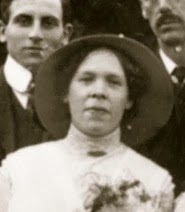
Lily, or Another Sister?
The young woman in the left picture is most likely one of Lily's sister in her wedding party. And the woman on the left could be the same sister in 1914 or (I think), it is Lily. Her husband, Lionel Waller, would have been back in uniform in late 1914, as Britain was at war, so that explains why he is not in the picture. I shall ask Cousin Joy what the date of the wedding was.
Sara Meadows?
This lady gets her own posting, because she was not in the 1904 photo, but is standing next to Frederick Martin Meadows in the 1914 photo. There is such an overwhelming resemblance to a couple of my immediate family members, that I think she has to be Sara Plowman Meadows, Lily's mother. She lived until 1919, so where was she in 1904 ?
Frederick Martin Meadows
This fellow is quite clearly the same person, and given his prominence in both wedding photos, we can safely assume that he is the father of Lily Maud and Stanley Arthur Meadows - Frederick Martin Meadows.
One of the Grandmothers?
All right. I will do this one person at a time so that there is a separate posting to refer to for anyone wishing to comment, either in agreement or disagreement, or, hopefully one day, someone coming across this who knows with certainty who is who. I always live in hope.
The pictures on the left will be from the 1904 wedding of Lily Maud Meadows and Lionel Percy Waller, and the pictures on the right will be from the 1914 wedding of Stanley Arthur Meadows and Ethel (surname to come).
I think these two characters might be one and the same. And probably one of the grandmothers? I haven't got dates of death for either of them, but Sarah (Payne) Quinton is the more likely candidate as she would have been 73 and 83 when the photographs were taken, and Mary Ann Meadows would have been 86 and 96.
Subscribe to:
Posts (Atom)


.jpg)


.jpg)