William Pitt Adams


This is rather interesting: Isabella's and George's son William Pitt Adams was born in Chester in 1884.  Why? 

Chester (United Kingdom)

His siblings, Alice and Sam, were born in (what would become) Bournemouth ahead of him, and his brothers John, Frederick, Leonard, and Reginald were born in Bournemouth after him.  What was Isabella, and perhaps the rest of the family, doing in Chester in 1884?  Could this have anything to do with a possible return to Liverpool after going to the U.S.?  Look how close Chester is to Liverpool.  If this was the case, perhaps Isabella did not know she was pregnant in the spring of the year - I cannot imagine she would have set out to cross the Atlantic to look after her brother if she knew she was pregnant - and William was born after her return, at the end of October.

If I ever manage to find out if it was Isabella that went to America, and if 1884 was the year, then we can connect these events.  Or, there is an entirely different reason why she/they were in Chester at the time... but, what?

Picture credit: http://www.onlinegalleries.com/antiques/d/chester-by-louise-ingram-rayner/91871

Slow Going


Steamboat Quebec
Steamer, Quebec City, c.1870

Steamer ST. ALBANS at Cleveland
Steamer, Cleveland 1875

Dead leads and dead ends have been the continuing theme of my recent research.  I have nothing substantial to relate at all, other than that I found a detailed family listing of Bartholomew Pearce's wife's family  for Cousin J., which has everyone on it up to the present family members, who live around or in London, Ontario!  Once again my old paths have been crossed with people connected to us of Portland origin.  The odd thing about this family listing is that they have Bartholomew's wife married to someone else on it, and I have not been able to find when he died, or anything else about him.

My latest mother lode of a discover has been the website for The Maritime History of the Great Lakes.  There are thousands of images and old newspaper transcriptions available here of all things related to shipping in the Great Lakes, and I have only just begun to look at it this morning.  I have lost my initial optimism that we will be able to find out anything more specific about how Bartholomew made it from Quebec to Cleveland, but it is possible to see how he could have  (if it was by inland steamer), by examining the pictures and articles in this repository of information.

Now, as today is the only day that everyone can get together this week, we are having a family feast/late birthday celebration for one of my nieces out at the farm - and it is a beautiful day for it - so, I must get to the preparations of my contributions now, and leave the Great Lakes for another day.

Light-house, Cleveland, Ohio - Lake Erie

image credits: http://images.maritimehistoryofthegreatlakes.ca/1452/data?n=1,  http://images.maritimehistoryofthegreatlakes.ca/454/data?n=39http://images.maritimehistoryofthegreatlakes.ca/1067/data?n=48

More About Steamships


I stumbled across a very good website this morning, and among other things, there was a transcription of the shipping news from the old Quebec Mercury newspaper on the day Bartholomew Pearce arrived.

Monday, May 22, 1871
Arrived, May 22:   S S Nestorian, Aird, Liverpool, May 11, Allans, Rae & co., mails, 855 pas and gen cargo for Quebec and Montreal:


Mail Steamship Arrived. –The S.S. Nestorian, Capt. Aird, from Liverpool, May 11, arrived in port at half-past three o’clock this afternoon, with the mails, 47 cabin, 808 steerage passengers and a general cargo for Quebec and Montreal.


And below is the text of an 1880 advertisement for the Allan Line, which was the steamship company that brought the most immigrants to North America in the last decades of the 19th century.  It gives a lot of information on the procedures and conditions of the passage, keeping in mind that this was 9 years after Bartholomew traveled and things might not have been exactly the same.

GOVERNMENT ASSISTED PASSAGES
AGRICULTURAL LABOURERS TO QUEBEC, AT œ5. FEMALE DOMESTIC SERVANTS AT œ4.
ALL APPLICATIONS FOR SUCH PASSAGES ARE TO BE MADE UPON SPECIAL FORMS, WHICH CAN BE OBTAINED FROM THE UNDERSIGNED, OR ANY OF THEIR AGENTS
Intermediate or Steerage Passages can be engaged by payment of a Deposit of One or Two Pounds on each berth, with Name and Age of each passenger. Post-office Orders to be made payable to the undersigned, Steerage Passengers are provided with comfortable sleeping compartments, and they are recommended to hire the Outfit supplied by the "Allan" Steam-ship Company, which consists of Woods' Patent Life-Preserving Pillows, Mattress, Pannikin to hold 1.5 pint, Plate, Knife, Nickel-plated Fork, and Nickel-plated Spoon. The Charge for the use of these articles for the Voyage is 6s. per Adult, and 3s per Child between the Ages of Two and Eight Years; leaving Passengers to provide bed-covering only, a rug or blanket being sufficient.
Intermediate and Steerage Passengers are allowed ten cubic feet of Luggage free for each adult; for all over that quantity a charge of 1s. for each cubic foot will be made. Packages of baggage must be distinctly addressed before being shipped.
BAGGAGE TAKEN FROM THE OCEAN STEAM-SHIPS TO THE RAILWAY CARS FREE OF EXPENSE.
Intermediate and Steerage Passengers embarking at Liverpool must be at the Office of the Agents, ALEXANDRA BUILDINGS, JAMES STREET, not later than Eight o'clock in the Evening of the day before the advertised date of sailing, by which time the balance of the Passage-money must be paid.
Passengers embarking at Londonderry will have to report themselves at the office of ALLAN BROTHERS & CO., Foyle Street, Londonderry; and Passengers embarking at Queenstown will have to report themselves at the Office of JAMES SCOTT & CO., the evening before sailing date, any time up to Eight or Nine o'Clock. The Steamers being under Mail contract, sail punctually on their appointed dates.
All Passengers will have strictly to conform to the rules laid down by the Company. Passengers' Boxes (if required on the Voyage) should not exceed fifteen inches in height.
AN EXPERIENCED SURGEON IS ATTACHED TO EACH STEAMER.
Intermediate and Steerage Stewardesses are provided by the Company, to attend to the wants of Female Passengers and Children. Through Tickets issued to all Inland Towns in Canada and the States. For further particulars apply to:
JOHN WARD, Stationmaster, Bandoran.
Liverpool, February, 1880.


Report credit: http://jubilation.uwaterloo.ca/~marj/genealogy/children/inthenews.html#1871
Image credit:  http://www.photoship.co.uk/JAlbum%20Ships%20Misc/Miscellaneous/slides/
Advertisemnt credit:  http://www.proni.gov.uk/index/exhibitions_talks_and_events/19th_century_emigration_to_the_north_america_online/at_the_port/advertisements.htm


Wrong Again


When I found the same ship's list on the LDS site, it listed the passengers in nice, clear text, not 19th century handwriting - and the one following Mr. Pearce was a "Miss. Peaton", not a Miss. Pearce after all.   Just when it was looking promising.

Back to the old drawing board.

I wonder...


Is this it?  The reason I could not find an Isabella Pearce on any of the ships' passenger lists the first time around was because she may have been listed as "Miss Pearce" - as in the Miss. Pearce on the above record - the fifth from the bottom.  This Miss. Pearce (listed as a spinster) and apparently travellng with a Mr. Pearce, who may have been a brother (?) was aboard the SS Circassian, and arrived in Quebec on the 22nd of September, 1873.  It fits.  But is it her?  I realize that this image is total crap to look at, and I shall try and make it better when I get home to my own computer. 

Happily, I can confirm that there is an Isabella Pearce showing up in the LDS records of Canadian ships' passenger lists, but, I would have to pay to see the record.  I found that an hour ago and have been trying to figure it out another way now, as I am not going to get to an LDS family research center in the next week.  We're onto something though.  Once A.R. mentioned in yesterday's email that she'd been speaking with a cousin of my grandmother's, who also remembered the story as being that it was Isabella that went to America, I decided to have another try at finding her on a ship's list somewhere.

And if this is our Isabella, who was the Mr. Pearce she was travelling with, I wonder?  And did he stay in North America?

The Next Generation


It's official: I am a great-aunt.  Young Trot made his way into the world a week later than expected yesterday, with a little encouragement from his waiting medical team.  Mother and child are doing fine.  And so begins the next generation of the family!!

And no, they have not actually named him Trot.  Read   David Copperfield. My favorite character in all of Dickens is Betsey Trotwood.

In other (less significant) news, I harvested my grapes yesterday afternoon and have over 42 lbs of them for H. to make  a lot of grape jelly.  I cannot abide grape jelly, so off they go to someone who can make use of them.  Then the dogs and I had our own little harvest festival afterwards with a glass of wine (me) and the hounds being allowed to scoff all the fallen grapes once I had cleared up the unripe and withered ones.  It was one of the last glorious days of summer in the garden - around 30 degrees -  and I was home from work early enough to enjoy most of it.

Not a thing to report on the genealogy front.  I haven't done any work on family research in the last few days.

How to Get to Cleveland in the 1870s


Cleveland in the distance taken from Euclid May, 2012

So... there you are, a sea-weary new immigrant fetched up in the port of Quebec in 1871.  What do you do next?  Have you already got a final destination further on, and arrangements made to get there?  Have you got a job waiting, or  a vague promise of one that is certain to materialize when you present yourself?  Were you chosen for emigration, and perhaps had your passage paid, because you have a skill the New World needed in abundance?  [Stone masons certainly fitted into that category in the late 19th century.]  Quebec City was the main transfer point for European immigrants heading to the mid-west and western United States during the last four decades of the 19th century, as it was linked by waterway and railroad right out to the Pacific by then.  Apparently, the ship fares to travel to Canada were cheaper, which was a major factor in choosing to come through Quebec rather than a U.S. seaport.

Bartholomew Pearce could have made his way from Quebec City to Cleveland either by railroad or by an inland passage lake or river steamer.  It would be very interesting to find out what happened after he landed in Quebec, but other than finding out his port of entry into the U.S., and then perhaps being able to infer from that how he traveled, there may not be an awful lot more to discover at the moment about any of this.  It wasn't until 1895 that something called "St. Albans records " were started, which recorded all immigrant  border crossings from Canada into the U.S.


There is a webpage I've just found devoted to "Visions of a City in 1872" on the Cleveland Area History blog.  These are two views of the city at the time Bartholomew Pearce arrived.  

City of Cleveland, From Reservoir Walk

Cleveland, from Scranton's Hill


Ships' Lists and More Mysteries

R.M.S. Etruria at the Liverpool docks
Passenger ship docked  in Liverpool 1884

Here's an update on what I've been doing whenever I've had a few spare minutes during the past couple of days: searching ships' passenger lists for any sign of one of Bartholomew Pearce's sisters or mother travelling to Canada or the United States on her way to look after him when he was very ill.  A.R. emailed me this past weekend and recalled a memory she had of something Gangan (who was my great-grandmother, if you are reading this and do not know the family name for her),  had talked about years ago, and to the best of A.R.'s recollection it was this: one of Bartholomew Pearce's sisters (she thought it might be Isabella), or perhaps his mother, had gone over to America to look after him when he was very sick with some unknown affliction.  This is pretty interesting if you think about it: it wasn't like jumping on a plane these days to be with someone if they need you.  And it must have been something chronic, because by the time letters went back and forth across the Atlantic and arrangements could be made for a ship's passage for someone, Bartholomew would have been fully recovered from a passing illness.  Perhaps whoever it was that went over had intended to emigrate and then changed her mind.  Cousin J. said that he died of "malnutrition and stomach cancer" in 1909, so it wasn't a terminal illness that we are talking about beforehand.

So far, I have only been able to find one possibility, and that is a record of a Mary Pearce, aged 50 (which would be consistent with the age of B's sister Mary, born 1844), on a passenger list on the SS Parisian which arrived in Quebec May 12, 1895.  Again, this would be strange, because by then B's wife and children had long since arrived and joined him and they were all living in Cleveland - so he would have had his family to look after him.  I think that if someone had dashed off across the Atlantic to nurse him, it would be in that period before his wife and children had gone over.  But, he and his wife, Jane, did have 8 children, so any help would have been mercifully received I expect.   It's early days yet... more will be revealed.

Cousin J. has generously mailed me a copy of all the research she has collected on the Pearce side of the family, so there will soon be more to add and/or correct about what we know so far when that arrives in the post.


photo credit: http://www.flickr.com/photos/10741688@N06/3454422046/in/photostream

The SS Nestorian

Nestorian

Using information from the freshly minted addition to the known family (who I shall call Cousin J.), I found an image of the ship that Bartholomew Comben Pearce sailed on to the new world.  The SS Nestorian left Liverpool on May 11, 1871, stopped at Londonderry May 12th, and arrived in Quebec City on May 22nd, 1871.  This photograph was taken in 1867, the web site says, which was the year of Confederation.  Canada was less than 4 years old when Bartholomew Pearce arrived in Quebec.

And I went to the Library and Archives of Canada website for immigrant ships' passenger lists and found an image of the original listing of Bartholomew's name on the Nestorian's passenger list.  His is the fourth from the bottom.  He is 31 years old, a "Lab", meaning laborer (we know from Cousin J. that he was a stone mason in Cleveland, and from Portland censuses that he was a quarryman), and the tick mark in the illegible column sub-categorizes him as English and something else I cannot decipher.


image credits: http://www.theshipslist.com/pictures/nestorian1867.shtml, http://www.collectionscanada.gc.ca/genealogy/022-908-e.html

Bartholomew Comben Pearce


This is very exciting.  I have had email contact this week from a direct descendent of Isabella's older brother, Bartholomew Comben Pearce, and this distant cousin sounds lovely.  She lives in Cleveland, Ohio, which is even more fun, because of my connection with that part of the States, and has got all kinds of information to share, as she has been working on family research since the 1980s.

Bartholomew Comben Pearce immigrated to the U.S.A. in 1871, via Quebec (not sure how long he stayed there yet), and lived out the rest of his life in Cleveland, working as a stone mason.  So, now we know the fate of the first of Isabella's siblings.  I shall update and correct all information as I get it, and I think there might be quite a lot, from the sounds of things.

By the way, this is the same person that I had tried to contact using an out of date email address last year that I refer to in the September 26th, 2011 blog entry.


photo credit: isleofportlandpictures.org.uk

Worth A Look


Image Credit

I just found this BBC clip on the restoration work going on at St. George's Church in Portland.  There is a lot of our clan who were matched, dispatched, and burried there.


https://www.bbc.com/news/uk-england-dorset-18616933


Sixpenny Handley


Ho ho!  The net draws in.  Lucy Beach and her parents were from Sixpenny Handley - population: a few hundred - so they would have known the village pub landlord and his blue-eyed daughter in all likelihood, the one who married Isaac Gulliver.  Lucy's father and mother were William and Alice Beach, and Thomas Beach was probably William's brother (see previous entry in regards Thomas Beach).

And!  There are lots of Adams in the records, so this is likely another crossroads for a Cranborne connection too.  Here's what A.R. had written to me a week or so ago:

Just an interesting snippet I gained from [Grandma's cousin] today.  I was bringing her up to date with your findings, and when I mentioned Sixpenny Handley, she remembered a little thing that always interested her.  Her father worked for the Post Office, and he either found out from there, or else went to Sixpenny Handley, and found out that the Post Office there was run by two spinster sisters by the name of Adams.  So there were Adams all around the area.


This is the sum total of my findings for the weekend.  I have also had communication from someone through this blog on the Caish/Hyde side and there may be more information coming from him soon.   I have only just emailed him back - his message had come in days ago.  Here's hoping he is a real person that we might be connected to, and not some other sort of internet-trawling party.


photo credit: http://www.geograph.org.uk/photo/1868534

Tarrant Hinton

Off I trotted to see the Latter Day Saints two weeks ago.  Alas, no one was there; the doors were all locked up and I couldn't see any sign of life in the sprawl of buildings.  So much for the family research center hours of operation posted on their website.   Clearly, I will have to call and speak to someone next week, but it will be a while before I get back there again as summer is in full swing with visitors and things happening.

And so I have been acquainting myself with Tarrant Hinton this weekend, the birthplace of Caroline Hyde's mother.  [I have come to a complete dead end with Thomas Hyde, so have left him for later.]  Caroline Hyde's mother was named Martha Caish, and she was baptized April 20th, 1767 in the church of St.Mary.  The first record of a marriage involving a Cash/Caish/Cosh (the spellings vary over the years, but are clearly the same family) in the Tarrant Hinton records that survive was from 1753.  This is the marriage of Henry Cash and Lucy Beach, who are Martha's parents.  And the first Beach to appear in the marriage records is one Thomas Beech who married Hester Aishford in 1739 - Lucy's parents, presumably (still haven't checked this line).  So neither of the fathers had been from the parish it seems.

There are eight little villages along the Tarrant valley all bearing the name of the stream, and Tarrant Hinton is the second one from the river's source, and virtually at the intersection with the ancient  Blandford Forum to Salisbury road.  And what lies just 6 or 7 kilometers further along the road toward Salisbury?  The village of Sixpenny Handley, which is where Isaac Gulliver (1745-1822) married the daughter of the local inn keeper. If this smuggler relation named Captain Hyde was real, it is most likely that he would have been living in the time of these generations I am looking at now.  Wherever Thomas Hyde was from, the digitization of the  records related to him has not been done for that parish, because I can find no trace of him yet in my internet searches, beyond his marriage to Caroline Hyde. Which means that I have no idea who his father and brothers were either, any one of whom might have been the elusive "captain" himself.  There is a Hyde Hill on the map very close to Tarrant Hinton though, I noted.

What the Duce?


???

It was my first foray back into the family records this past weekend, and what did I find?  That three girls were christened on the same day in Cranborne - May 15th, 1888 - with parents named George and Elizabeth Jane Adams.  What on earth is this?  I looked through the baptism records and could not find any other George Adams born after or near our George, nor could I find ANY other George Adams in the Cranborne censuses up to 1871.  And how coincidental that this potential other George also had an Elizabeth Jane for a wife.

My suspicious side is taking over my confused side and beginning to smell a rather large rat.  Could George have been leading a double life?  Our George was in Bournemouth and legally wed to Isabella in 1888 and having children with her.  Who are these girls (surely they were not triplets, but just all christened on the same day for some reason), and where do this other George and Elizabeth Jane Adams fit in if they are not the same ones?!  There must be a logical explanation somewhere, because no one would be stupid enough to christen his children in his home village church if he was supposed to be married to someone else in another town, which everyone would have known about in little Cranborne.

One explanation that I'd already thought about when I couldn't find any record of death for Elizabeth Jane Adams, is that she did not die earlier, but was in an assylum/sanatorium (perhaps the marriage was annulled?), and so she might have had more children that George later adopted as his own, in law or name, that were christened in the church at Cranborne.  It is all very interesting and potentially very sad.

Or - Occam's Razor - the simplest explanation is that there was another couple named George and Elizabeth Jane Adams living about the same time in Cranborne ... if only I could find such a George and Elizabeth Jane in the records.  ANYWHERE.

Here are the three girls names: Lilian May Adams, Constance Ethel Adams, and Nelly Catharine Adams.

How will this all turn out?

Her Majesty's A Pretty Nice Girl


Queen Elizabeth Doesn't Drink Beer    


As an ex-pat and a colonial (by virtue of dual citizenship) with small 'r' republican leanings, I am perfectly happy to follow the occasional burst of high theatre staged on behalf of the House of Windsor: weddings, funerals, state visits, and other "royal rubbish", as my decidedly anti-royalist pater refers to anything at all to do with the monarch and her family.  But the Diamond Jubilee celebrations for the Queen are somehow different and have made me think a bit more about someone who has always been there in the background, but about whom I have never given any serious thought.  Her image is seen daily on our money and stamps and hanging in all public buildings in the land, and every large city in Canada has at least one school or hospital named for her, but at no time in the development of the average kid growing up here does anyone seem to actively encourage any particular allegiance or attachment to the Queen and the monarchy.  So, why do I care about this person at all?  Why do I find myself feeling strong affection for her now?  I do not know.  It's obviously not for the person herself, as I don't know her, or for the list of  reasons trotted out ad nauseum by all who are true monarchists, i.e. how hard she works, her devotion to duty, her dignity and composure, her sharpness and purported intelligence.  All these qualities are enough to inspire admiration, certainly, but not affection.  Does she not represent the pinnacle of the entire heap of corrosive sludge that is the (en)titled class in Britain, for whom I feel nothing but a distant contempt, or sorrow?   Yes.  And no.  In reality, she is as much removed from 'them' as she is from everyone else.  And the trade-offs for her über-wealth and privilege cannot possibly be worth it.  I would have put my own head into the guillotine and pulled the release lever myself long before my sixth year on the throne, never mind the sixtieth.


Undoubtedly, my feelings have more to do with the Queen as a powerful national symbol for my motherland, for a place of myth and fiction and shared history that is as compelling to me as the mythic and historic Elizabeth II is herself in a way.  She is the one thing all of us have had in common, certainly for my whole life,   as part of the backdrop of the times we live in.  So, is the affection felt for her merely an overflow of goodwill based on tribalism, and the comfort of secure familiarity?   Perhaps - if you are the sort of person that likes to go through life thinking in a state of reductive blandness.   Without having come to a better conclusion after giving it thought this Jubilee Weekend though, I have nothing more to add but my own good wishes to the mountain of them already offered: Long Live the Queen!    Happy Diamond Jubilee old thing.


Slow Return to Normal


My heart is still not in this, and I have been working all hours for the last few days, but I have managed to get to a long overdue redesign of the blog this evening.  It was more time consuming and fiddly than difficult, so it was the perfect project for an overstimulated brain.  The new image across the top was taken in Lacock last spring. The pictures on this posting were some other candidates for the 'mast head' with closer connections to our family, being ones of Weymouth, Fontmel Down, and Hengistbury head with the Isle of Wight in the background.  I just liked them, so thought I'd pop them up here for others to see.

Oh yes - and the new blog title is taken from "On A Fine Morning", by the Dorset poet and novelist, Thomas Hardy.


Change


I think the sea has thrown itself upon me and been answered, at least in part, and I believe I am a little changed - not essentially, but changed and transubstantiated as anyone is who has asked a question and been answered. 
                                                                            Hart Crane

After a sudden departure from all that was normal in my little life, and then a couple of weeks spent in the American mid-west and nearly 2,000 km in a car each way,  I am home and back to the blog again.

So far, this project has focused on the past lives of one branch of my family, but recently, I was thrust upon a journey in the intense present with another branch, as we accompanied a singular man through his last days.  He was my father's only sibling, and someone who no one was ready to lose.  But, of course, we have no say in these matters, and when a previously treated melanoma turned out to have metastasized to his brain, the time between diagnosis and death was swift.

And so, another dear soul has joined our ancestors.  I hope that all of them had the good fortune to have had even a fraction of the love and esteem that Uncle Rob had in his life.  Rich, indeed, would they have been.

Uncle Rob's Garden

Loss


Multa ferunt anni venientes commoda secum; 
multa recedentes adimunt.
                                     - Horace 

(The years, as they come, bring blessings, and as they go, take blessings back again.)


Interesting Occupation Listings


Here are some interesting occupations I've found listed on 19th century census returns:

                        - Umbrella maker
                        - Cordwainer
                        - Gingerbread maker
                        - Photographist
                        - Medical Officer & Public Vaccinator
                        - Tobacco blender
                        - Ostler
                        - Fly proprietor
                        - Scripture reader
                        - Collector of Poors' Rates & Income Tax
                        - Staymaker
                        - Brush maker
                        - Fishing rod maker
                        - Corn Inspector
                        - Tallow chandler and soap boiler
                        - Percussion cap maker [ammunition]

Imagine living in a town where there  is such a demand for gingerbread that you could have a career as a gingerbread maker.  And to save you looking it up, a cordwainer was someone who made luxury shoes and boots out of the very soft 'Cordoba' leather from Spain.

I'll add to this list as I note other interesting occupations.


May Day


Photo credit
First things first: I have seen another picture of the suspected Adams shop, taken in 1939, and it is indeed Adams on the newer sign. Alas, this picture is on a commercial postcard site, so I cannot put it on this blog. Although, I suppose if I were to order a copy of it, then I could do what I like with it, as I believe there are no copyrights on old postcards (? - will check into that). In the mean time, if you go here:  http://www.francisfrith.com/cranborne/photos/   you can enlarge the thumbnails and see for yourself.


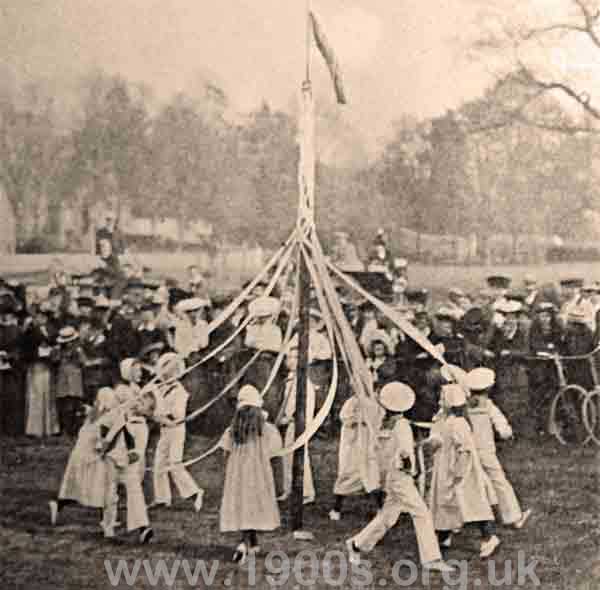
Children in the early 1900s dancing round a maypole on May Day (May 1st).
On the same site, you can look at the "Memories" page for Cranborne, and one of the ancestors of the Adams that owned the shop when the picture was taken has written a note.  He must be a third cousin 4 times removed, or some such thing.  I'll have a look for the people he mentions and see where they come in.  So far, I haven't gone forward with any of George's uncles and aunts and their offspring.  It will be one of Thomas's brothers that was the shoe and boot maker, and his son(s) that took over from him.


Another interesting thing on this website is a note from a person who writes that he remembers seeing the Hindenburg (!) fly over Cranborne. I looked it up and found out that the Luftwaffe used the Hindenburg to do some reconnaissance photography while it was touring over southern England in 1936, and it is known that it flew over Portsmouth and Plymouth (the two main British naval bases), so it's entirely possible that the airship was spotted from Cranborne.  I expect Portland Harbour would have been of great interest to the Germans too.


As it turns out, it is the 75th anniversary of the Hindenburg disaster in 5 days.

To the garden with me now.  It has warmed up sufficiently to start on phase II of the fish pond relocation project.